

Talking to strangers online used to mean Omegle. Since it shut down in 2023, that role has split across apps like Emerald Chat, OmeTV, and Chatroulette. Emerald Chat leads on safety, using AI screening, human moderators, and a karma system that most competitors do not have.
Key takeaways
- Omegle shut down in 2023 after facing legal pressure and years of safety complaints, and no single app has replaced it completely.
- Emerald Chat combines AI and human moderation with a karma system, which most Omegle style apps do not offer.
- OmeTV and Chatroulette are close in speed and simplicity, but neither one screens users the way Emerald Chat does.
- Interest based matching, not just random pairing, is becoming the feature people actually want from a chat platform.
Editor’s note: this guide is reviewed and updated as new random chat platforms launch and older ones shut down, since this space changes fast.
You probably do not care about the history of a site that closed three years ago. You care about which app actually works now, and which one you can open without wondering who is on the other end.
Omegle answered that question for over a decade, badly at times, but it answered it. Its shutdown left a real gap, and a handful of random chat platforms are all claiming to fill it.
They are not the same, even when their landing pages look almost identical. Some copied the interface and stopped there. Some added better moderation and more control over who you talk to.
This guide walks through how the biggest names in random video chat compare, so modern users looking to talk to strangers online can pick the one that actually fits what they want from a conversation with a stranger.
Quick comparison: omegle vs other video chat platforms
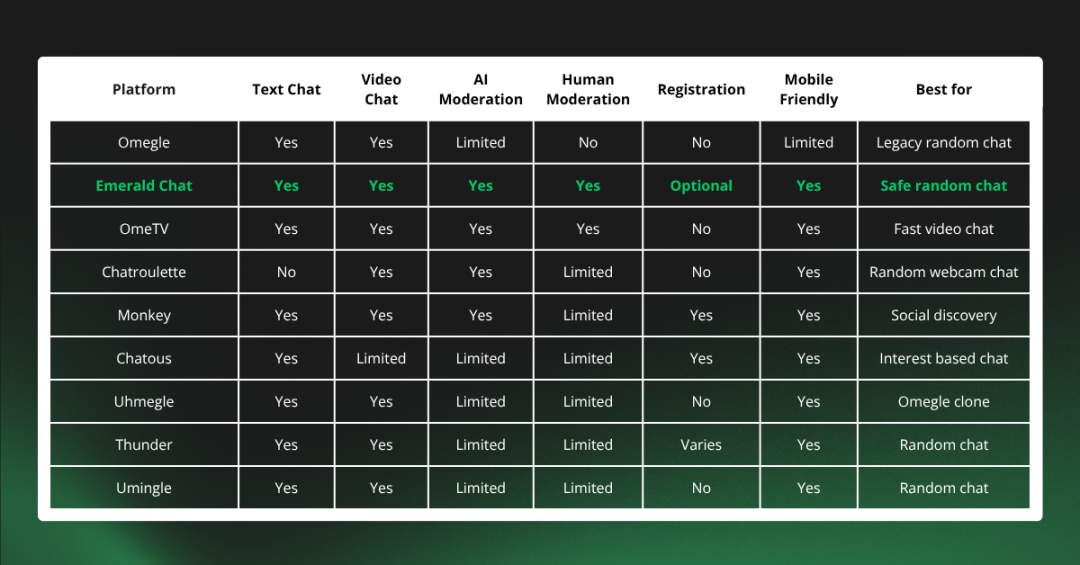
A table like this only tells you so much. Two apps can both say “AI moderation” and mean very different things by it, and the basic features listed on a landing page rarely tell you how a video chat platform actually feels once you start chatting.
What happened to Omegle?
For a long time, sites like omegle were the easiest way to get a quick video chat with a random stranger with zero setup. Omegle’s founder shut the site down in November 2023, after 14 years online. He said running it was no longer sustainable, financially or personally, and pointed to the legal cases piling up around how the platform had been used.
Omegle had a reputation for exposing minors to predators, and for pairing people up with no real screening in between. Reports of harassment and abuse were common enough that “Omegle” became shorthand for the risks of talking to strangers online.
Once it closed, the demand did not disappear. It scattered. People still wanted quick, spontaneous video chats with a random stranger, but with actual guardrails this time. Better moderation.
Reporting that works. Some sense the person on the other end had been through a filter first.
That search for what actually replaced Omegle is really a search for those guardrails, and it is why so many people now type “best omegle alternatives” into Google instead of just going back to the original site.
It is also worth knowing that not every Omegle clone is an independent project. Several of the smaller, lookalike sites are built and run by overlapping teams, sometimes even the same ownership group, which is part of why so many of them feel identical once you start chatting.
What makes a good Omegle alternative?
A few things separate a real omegle alternative from a clone with a new logo.
Active moderation matters most. That means real people reviewing reports of inappropriate behavior, not just an algorithm quietly banning accounts with no explanation.
Pew Research Center found that when Americans experience online harassment, a stranger or someone whose identity they never learned is behind the incident about half the time.
That is the exact risk moderation is meant to catch. Real users matter too. A platform full of bots defeats the point of random chat before you even open it.
Privacy comes next. You should be able to talk without handing over personal details like your name, location, or face if you do not want to. Some sites ask for a video selfie during sign up just to confirm you are a real person and not a bot, which is a reasonable trade for user safety. Mobile support matters because most of this traffic happens on a phone, and a clunky mobile site kills the experience fast.
Security measures beyond moderation matter too. A good chat platform should have malware blockers in place to catch malicious links before they reach you, since strangers sending sketchy links is one of the oldest tricks in random chat.
If privacy is a bigger concern for you personally, pairing any random chat app with a tool like Private Internet Access or another one of the best VPNs adds a layer of protection the platform itself cannot give you. Basic caution still matters. Stay cautious about what personal details you share with strangers worldwide, no matter how good the platform’s security measures are.
Then there is the matching system. Pure randomness gets old. A platform that lets you filter by interest, or offers gender and location filters so you have more control over who you land on, tends to produce better conversations than one that just throws two strangers together and hopes.
Clear community guidelines and a respectful environment round it out. If you have to dig through settings to figure out how to report inappropriate behavior, the platform has already failed you once.
Emerald Chat vs Omegle
This is the comparison most people searching for Omegle alternatives actually want answered, so it gets the most space here.
Safety
Omegle had almost no age verification and limited filtering. Emerald Chat mixes AI screening with human moderators, plus a karma system that flags users who misbehave. No platform can promise nothing bad ever happens, but something is actively working in the background here.
Moderation
Omegle’s moderation was reactive. You reported something, and maybe someone looked at it. Emerald Chat pairs automated detection with a human team, so flagged behavior actually gets reviewed, and karma gives people a reason to behave.
User experience
Omegle’s interface barely changed in over a decade. Emerald Chat was built with a user friendly interface for how people browse now, with a mobile friendly layout and a faster path into a video chat. It is completely free to use, with sign up optional rather than required, and it supports group chats too, not just one on one video calls.
Matching features
Omegle gave you almost nothing beyond typing shared “interests” that rarely matched anyone. Emerald Chat’s interest tags actually narrow the pool, so two people start already knowing they have something in common instead of a flat “hey, where are you from.”
Community quality
A platform is only as good as the people on it. Emerald Chat’s karma system pushes low effort or abusive users away from everyone else, which changes the average conversation more than people expect. It also makes spotting bots easier, since accounts with no real activity tend to stand out fast.
Privacy
Neither platform requires personal details to chat. Emerald Chat lets you stay anonymous while still giving you working tools, like reporting and blocking other users, that Omegle never built out well.
Who should choose Emerald Chat?
If you want the speed of random chat without walking in blind, this is built for that. It suits modern users who want an actual conversation and meaningful connections with strangers, not just a five second video before someone clicks away. For people who want more control over who they meet, upgrading also unlocks filters for other countries and languages, which the free option does not include.
OmeTV vs Omegle
Similarities
Both are built around instant, random video pairing, with no real setup before you land in a conversation.
Differences
OmeTV added moderation and gender filtering Omegle never had, and leans more mobile first.
Pros and cons
OmeTV is fast and easy, with real moderation gains over Omegle. It still lacks the deeper matching and karma system that shapes who you actually talk to.
Which is better?
OmeTV wins on speed and basic safety. Emerald Chat goes further with interest matching and moderation built around ongoing behavior, not just one time reports.
Chatroulette vs Omegle
Features
Chatroulette is video only, no text chat. It focuses entirely on the webcam experience, sometimes with AR face filters thrown in for fun, which is either exactly what you want or a dealbreaker.
Safety
Chatroulette added AI moderation to catch obvious violations, like adult content, in real time. Human review is more limited, so some things slip through that a person would have caught.
Moderation
Automated systems handle most of the first pass. That catches a lot, but it is not a substitute for a human looking at a flagged report.
User experience
The interface is simple, almost stripped down. It just does not offer much beyond the basic roulette format.
Verdict
Chatroulette works if all you want is fast, random video with no frills. For anything closer to an actual conversation, Emerald Chat’s interest matching gives you a better starting point.
Monkey App vs Omegle
Audience
Monkey App skews younger and leans social, closer to Snapchat with a random chat feature bolted on than a dedicated Omegle replacement.
Features
It layers in social discovery tools, like adding people after a chat or letting users send virtual gifts to keep an interaction going, that go beyond the one and done format Omegle used.
Safety
Registration is required, which adds a layer Omegle never had, though human moderation is still limited.
Best use cases
Monkey works well if you want to build a small social circle out of random chats, not just have one anonymous conversation.
Verdict
Monkey is built for a different goal than Omegle was. If you want genuine random conversation with moderation behind it, Emerald Chat stays closer to what people originally liked about Omegle.
Chatous vs Omegle
Text chat experience
Chatous puts more weight on text than most competitors, closer to a chat app with different chat rooms and video as an option rather than the default. You can start chatting in one of several online chatrooms built around a topic instead of just landing on a random stranger.
Interest matching
This is Chatous’s strongest feature, matching by shared interests and hashtags, something Omegle only gestured at with its old interest tags.
Privacy
Registration is required, which some users will not want if anonymity was the whole appeal of Omegle to begin with.
Verdict
Chatous is worth trying if you care more about text than video. Emerald Chat offers similar interest based matching without requiring an account.
Uhmegle vs Omegle
Interface
Uhmegle copies Omegle’s look almost exactly, down to the layout.
Features
It offers the same basic text and video pairing Omegle had, with little added.
Moderation
This is the weak point. Moderation is as limited as Omegle’s was toward the end, which is part of why Omegle became a safety problem in the first place.
Verdict
Uhmegle is nostalgia more than an upgrade. For a safer version of the same idea, Emerald Chat is the better fit.
Thunder vs Omegle
Features
Thunder offers standard random text and video chat, without much beyond the basics.
User base
The user base is smaller and less consistent than the bigger platforms here, which affects how fast you get matched.
Safety
Moderation is limited, with no karma or reputation system tracking behavior over time.
Verdict
Thunder works in a pinch, but it does not solve the problems that sent people looking for an Omegle alternative in the first place.
Umingle vs Omegle
Features
Umingle mirrors Omegle closely, with random text and video chat and minimal extras.
Similarities
Both rely on pure random pairing with little user control over who you talk to.
Differences
Umingle has slightly more filtering than old Omegle did, though it still falls short of platforms with dedicated moderation teams.
Verdict
Umingle is another close copy rather than a real step forward. Emerald Chat’s moderation and matching go further.
Omogle vs Omegle: is there a difference?
“Omogle” is not a separate platform. It is almost always a typo for Omegle, and sites using that spelling are sometimes clones capitalizing on the misspelling. If you searched “Omogle,” you are almost certainly looking for Omegle itself, which no longer exists, or for a safer alternative like Emerald Chat that actually has moderation behind it.
Ryan vs Omegle
This search term is ambiguous. It likely refers to a streamer, YouTuber, or app feature associated with Omegle at some point, rather than a standalone platform. “Ryan” is not a known Omegle competitor. Your safer bet is an established alternative like Emerald Chat, which has actual moderation and reporting tools in place.
Omegle vs other chat apps
Omegle was never really in the same category as Discord, Snapchat, Telegram, WhatsApp, or Facebook Messenger, even though people compare them.
Those apps are built for talking to people you already know. Omegle was built for talking to people you have never met. Discord comes closest to a hybrid, since its servers let you meet strangers around a shared interest, but it still works more like a community hub than a random pairing tool. Snapchat, Telegram, WhatsApp, and Messenger all assume an existing contact list. None of them do what Omegle did: drop two strangers into a conversation with zero setup.
Privacy works differently too. Messaging apps tie your identity to a phone number or account. Random chat platforms, Emerald Chat included, let you start talking without handing that over.
Omegle vs other video chat apps
Inside the video chat category, there are a few distinct types. Dedicated random chat apps, like Emerald Chat, OmeTV, and Chatroulette, focus purely on pairing strangers. Social discovery apps, like Monkey, blend random chat with features meant to turn one conversation into an ongoing connection. Video first platforms lean almost entirely on the webcam. Compared to other sites built around static profiles, this next generation of apps is built around live video calls with people worldwide instead.
Community moderation is what separates the useful ones from the risky ones. Mobile experience matters just as much, since most people are opening these apps from a phone, often between other things, not sitting at a desktop the way Omegle’s early users did.
Which Omegle alternative is best?
| Best for | Winner |
|---|---|
| Safety | Emerald Chat |
| Moderation | Emerald Chat |
| Finding real conversations | Emerald Chat |
| Anonymous chatting | Emerald Chat |
| Fast random chat | Chatroulette |
| Interest matching | Emerald Chat |
| Meeting people with similar hobbies | Emerald Chat |
| Overall | Emerald Chat |
The right alternative depends on what you actually want
Every platform here solves part of what made Omegle useful. Chatroulette is fast. OmeTV is simple. Monkey leans social. None of them combine safety, moderation, and real matching quite the way Emerald Chat does.
The right choice depends on what you want from a conversation with a stranger. If speed is all that matters, Chatroulette gets you there fastest. If you want meaningful interactions and a real shot at new friends, Emerald Chat is built for that, no tech enthusiast skills required.
Omegle is gone. What replaced it is a handful of platforms, each solving a piece of the puzzle, mostly around the old safety concerns that never really went away. Pick the piece you actually need.
Ready to try safer random chat? Start a conversation on Emerald Chat and see what interest matching feels like when it actually works.
Frequently asked questions
No single app replaced Omegle. Its audience split across platforms like Emerald Chat, a free random video chat option, OmeTV, and Chatroulette, each covering part of what Omegle offered, from random video pairing to text chat with strangers. The gap Omegle left is really several smaller gaps, and most people end up trying a few other random chat platforms before settling on one.
Emerald Chat has moderation and safety features Omegle never had, including AI screening, human review, and a karma system. Omegle no longer exists, so Emerald Chat is a working alternative rather than a direct comparison today. For anyone who liked the random pairing idea but wanted more protection, it is the closer match.
OmeTV added AI and human moderation Omegle lacked, along with gender filtering. It is a safer starting point than old Omegle was, though it has less depth in matching and reputation tracking than Emerald Chat. Both approaches reduce risk, but neither one can promise a completely safe conversation every time.
Emerald Chat combines AI moderation with human review and a karma system tracking behavior over time. Most other Omegle style apps rely more on automation alone, with limited human oversight. That combination of a machine catching obvious issues and a person reviewing the harder calls is what actually holds up over time.
Emerald Chat’s mix of AI screening, human moderators, and a karma based reputation system makes it one of the safer random chat options. No platform can guarantee complete safety, so basic caution still matters, things like not sharing personal details and reporting anything that feels off right away.
Emerald Chat is the strongest overall option, balancing safety, moderation, and interest based matching. Chatroulette suits users who want speed above everything, and OmeTV works well for fast, simple video chat. The right pick really comes down to whether you value speed or a genuine conversation more.
Leave a Reply